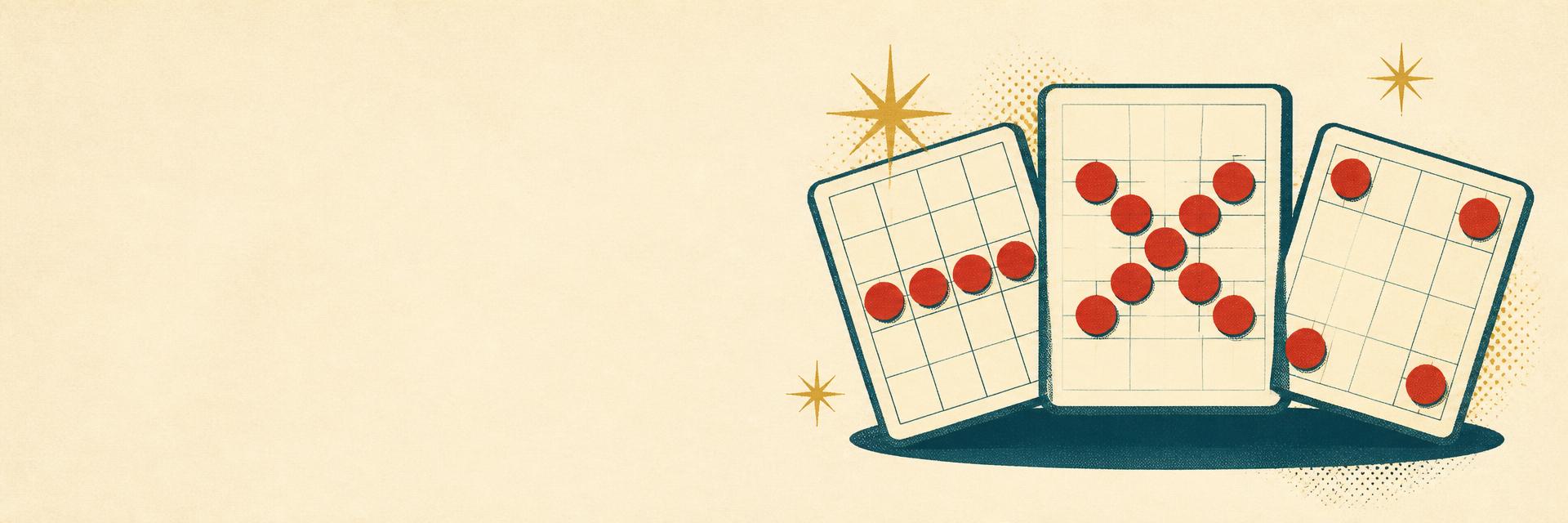
Classic bingo only requires a single line, but calling out different shapes on the card is an easy way to add variety to a long session. Below is a rundown of the most common win patterns, what they look like on a 5x5 card, and how each one changes how long a round takes. If you need the basics first, start with the how to play bingo guide.
Common win patterns
Straight line
Any single row, column, or diagonal fully marked. This is the pattern most people picture when they hear the word 'bingo.'
Fastest pattern — often the first winner in a large group.
Four corners
Only the four corner squares of the card need to be marked. No connecting squares are required.
Very fast, since it only depends on four specific numbers being called, regardless of order.
Postage stamp
A 2x2 block of squares in any single corner of the card, resembling a stamp in the corner of an envelope.
Quick, similar to four corners, but slightly less predictable since any of the four corners can complete it.
Letter X
Both diagonals marked from corner to corner, forming an X shape across the card, including the center free space.
Moderate length — two full diagonals take longer than a single line or the corners alone.
Picture frame (or outside border)
Every square around the outer edge of the card is marked, leaving the interior squares blank.
Longer than a single line since it requires 16 squares on a standard 5x5 card, but shorter than a full blackout.
Blackout / coverall
Every square on the card is marked, including the free space. This is the most complete pattern possible.
The longest pattern to complete — it requires calling nearly every number on the board, so it works well as a final round.
Speed bingo
Not a shape but a pace: numbers are called quickly, sometimes on a smaller card, so a single-line win happens in a couple of minutes.
Designed to be short by nature, useful for squeezing several quick rounds into a limited time slot.
How patterns change the pace of a session
Shape patterns are more than a novelty — they control how long each round lasts. A four-corners or postage-stamp round can be over almost as fast as it starts, which is useful for a quick prize between other activities. A picture-frame or letter-X round takes noticeably longer because it requires more squares to line up. A blackout or coverall round is the longest, and most hosts save it for the final round of the night since it guarantees nearly the entire card gets called before anyone wins.
If you are running a themed game like Christmas bingo or office bingo, the same patterns apply even though the squares hold words instead of numbers. Just call out items from the list in random order and mark them off the same way.
A good structure for an hour-long session is one quick pattern (four corners or a line) to get everyone warmed up, one medium pattern (letter X or picture frame) in the middle, and a blackout as the closing round. Track winners on a bingo score sheet so you can announce a running tally, and if you need reward ideas for each round, see the bingo prize ideas guide.
Frequently asked questions
What is the easiest bingo pattern to explain to new players?
A single straight line — any row, column, or diagonal — is the easiest pattern to explain and the fastest to complete, which makes it a good warm-up round before trying shape patterns.
What is the difference between blackout and coverall bingo?
They are the same pattern by different names. Both require every square on the card to be marked, including the free space, and both are typically played as the final, longest round of a session.
How long does a typical bingo game last with pattern variations?
A single-line game can finish in a few minutes with a large group, while a blackout or coverall round can take considerably longer since every square must be called before someone wins.
What is speed bingo?
Speed bingo calls numbers faster than usual, often skipping the pause between calls, and sometimes uses a smaller grid so games finish quickly. It works well when you want to fit many rounds into a short session.
Can I mix multiple patterns into one bingo session?
Yes, and many hosts do. A common approach is one line for an early, quick prize, a shape pattern like four corners or a postage stamp in the middle, and a blackout or coverall as the final round.
Ready to try a new pattern? Print fresh cards with the bingo card generator and call numbers with the free online bingo caller, which lets you announce which pattern is in play for each round.