
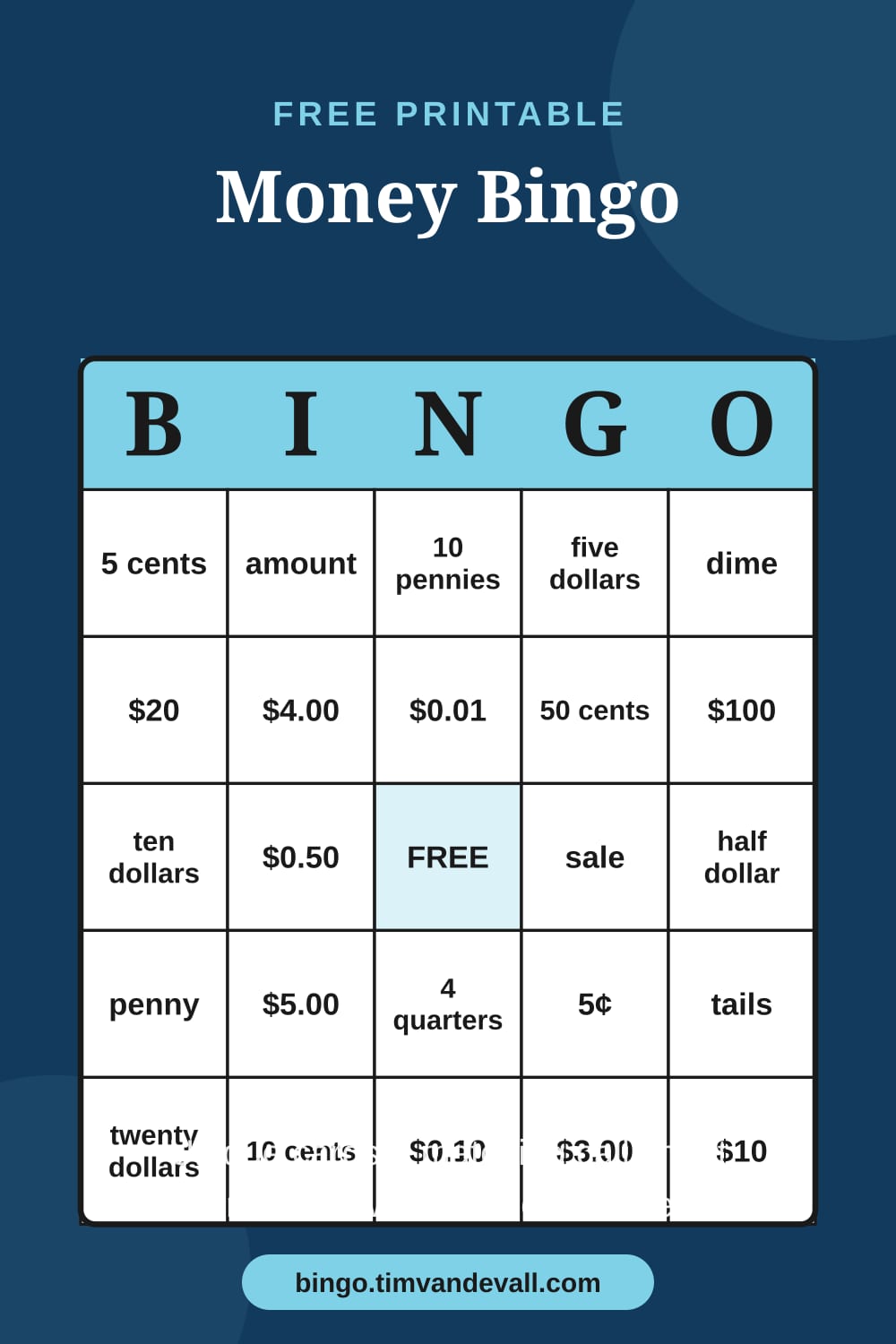
You call an amount or describe a group of coins, and students cover the matching square. It works for coin identification, counting practice, and making-change review in first through third grade.

Money Bingo
 FREE
FREEMoney Bingo
FREEMoney Bingo
FREEMoney Bingo
FREEMoney Bingo
FREEMoney Bingo
FREEMoney Bingo
Call Sheet
Cross off each item as you call it
How to play money bingo
- Print one card per student plus a call sheet for the caller.
- Call an amount, a coin name, or a description such as three dimes and a nickel.
- Students find the matching amount or coin on their card and cover it.
- The first student to complete a row, column, or diagonal calls bingo.
- Ask the winner to read back each amount to check for understanding.
Building a focused list
For coin identification, list the coin names and their values: penny, 1¢, nickel, 5¢, dime, 10¢, quarter, 25¢. For counting practice, add combinations like 2 nickels, 5 dimes, or 4 quarters.
When students are ready for bills, include $1, $5, $10, and $20 along with simple totals. Keep the list to 24 to 40 entries so every card has variety without being overwhelming.
Classroom and homeschool ideas
Play money bingo after a lesson on counting mixed coins, or use it as a math-center rotation while you work with small groups. Give students play money to build each amount before covering the square.
For a real-world connection, bring in a small set of price tags and have students find the amount on their card. That turns the game into a pretend shopping trip.
Pin this for later
Planning ahead? Save this money bingo page to your board so the generator is one tap away when you need to print. Every card is randomized, so you can come back and print a fresh set any time.
Save to PinterestFrequently asked questions
How does money bingo work?
Cards show coins, bills, amounts, or money words. The caller names an amount or describes a group of coins, and students find the matching square. The first to complete a line calls bingo.
What money skills can I practice?
Coin recognition, bill recognition, counting mixed coins, making change, and reading dollar-and-cent amounts all work well with money bingo.
Can I use only certain coins?
Yes. Edit the word list to include only the coins or amounts you are teaching. For beginners, start with pennies, nickels, and dimes before adding quarters and bills.
Is this good for first and second grade?
Yes. First graders can match coin names and values, while second graders can count mixed coins and make change.
Is money bingo free to print?
Yes. Cards, call sheet, and PDF are free for classroom and homeschool use with no watermark and no sign-up.
Need more for the lesson plan? Tim's Printables has free classroom worksheets and printables, and grab the printable blank bingo template if you would rather fill the squares in by hand.
You might also like
Math Bingo
Cards full of answers while you call the problems. Great for addition facts and times tables.
Fraction Bingo
Fractions and visual models for elementary math review. Call the fraction, find the match.
Numbers 1-20 Bingo
Number recognition practice for pre-K and kindergarten, one numeral per square.
Back to School Bingo
First-week icebreaker cards that get new students talking and learning the room.
Sight Word Bingo
Dolch and Fry sight words for early readers. A five-minute game that doubles as reading practice.
Phonics Bingo
Letter sounds, blends, and CVC words for early readers. A quick literacy center or small-group game.
Need the numbers called for you? Open the online bingo caller on a phone or TV, or browse every bingo theme.